
Shorter Visible Recovery
Sutures Can Sometimes Be Adjusted or Removed
Small Entry Points and Limited Scarring
Individualized Crease Shape
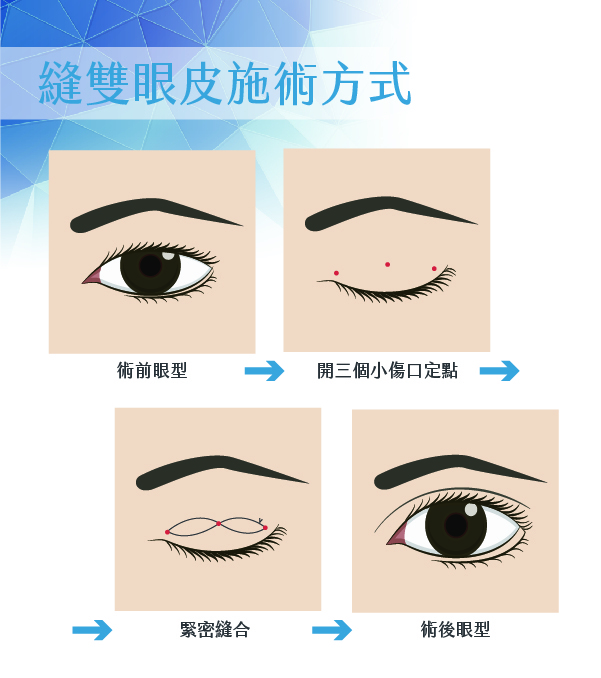
Suture double eyelid surgery creates an upper-eyelid crease by placing sutures through small entry points rather than making a full-length incision. It may suit eyelids with limited skin laxity, tissue thickness, and fat, and can adjust a low or absent crease or selected asymmetry.
The method does not remove substantial excess skin or fat and does not correct significant ptosis. Sutures can loosen, become visible or palpable, or require removal or revision, so an in-person anatomical assessment is important.

Upper Eyelid
| Method | Suture Method | Incisional Method |
|---|---|---|
| Often Considered For | Thinner, firmer eyelids |
Thicker or puffy eyelids |
| Durability | Sutures can loosen and the crease can fade | Generally more durable, but still changes with healing and aging |
| Anesthesia | Usually local anesthesia | Usually local anesthesia, sometimes with sedation |
| Typical Surgery Time | About 30–60 minutes | About 1–1.5 hours |
| Visible Recovery | Often 3–7 days | Often 1–2 weeks; final settling takes months |
| Suture Removal | Usually not required unless revision is needed | Skin sutures usually require removal |


Photos are published with the subject's consent and authorization. Surgical results may vary depending on individual conditions.
The suture method may suit thinner eyelids with little skin excess, fat, or ptosis. Incisional surgery may better address thicker tissue, puffiness, laxity, diagnosed ptosis, or a need for tissue removal. A surgeon should assess anatomy, eye opening, brow position, prior procedures, and desired crease.
Swelling and bruising are expected and are often most noticeable during the first several days. Many people look more settled after 3–7 days, but residual swelling, crease depth, and asymmetry can continue changing for weeks to months. Recovery varies by anatomy, technique, and healing.
There is no full-length incision, but small entry-point scars, dimpling, pigmentation, palpable knots, or exposed sutures can occur. These usually become subtle, but the procedure should not be described as scarless.
Selected treatments can be combined when each has a clear indication, but tear-trough filling, under-eye fat grafting, ptosis correction, and lower-eyelid surgery address different anatomy and risks. Complex concerns may be better treated with an incisional or staged plan. Combination can increase swelling and complications.
Local anesthetic reduces pain, but the injection can sting and pressure or pulling may still be felt. Soreness and tightness are common afterward. Severe or increasing pain, especially with vision change, requires prompt assessment.
Do not apply makeup over fresh entry points, crusting, or irritated skin. Some patients can apply makeup around—rather than on—the entry points after a short interval, but the safest timing depends on wound closure. Follow the clinic’s examination, use clean products, and avoid contact lenses until cleared.
Early asymmetry often reflects different swelling, bruising, muscle activity, or baseline anatomy. Persistent asymmetry can relate to suture position or tension, crease loss, ptosis, brow position, scarring, or planning. Reassess after healing; selected cases may need suture adjustment, removal, or revision.
Suitability depends on health and anesthesia. Report diabetes, seizures, bleeding disorders, abnormal scarring, allergies, cardiovascular disease, dry eye, thyroid eye disease, glaucoma, vision problems, and prior eye surgery. Active infection or inflammation should be treated first. Elective surgery is generally deferred during pregnancy; breastfeeding requires assessment. Patients under 18 need a legal representative. Provide all medicines and supplements—including aspirin and anticoagulants—and do not stop them without the prescribing physician. Avoid smoking and alcohol as instructed, follow fasting rules if sedation is used, remove makeup and contact lenses, and arrange an adult escort.
Use medicines, cold compresses, saline cleaning, and ointment only as instructed. Keep entry points clean and dry until cleared. Contact the clinic for increasing swelling, redness, bleeding, pus, fever, severe pain, vision change, headache, or nausea. Avoid rubbing the eyes, contact lenses, hot springs, swimming, soaking, smoking, alcohol, and strenuous activity for the specified period. Do not start or stop steroids or other medicines without advice.
Possible complications include bleeding, infection, prolonged swelling, asymmetry, crease loss, an overly high or deep crease, visible or palpable sutures, suture exposure, cyst or granuloma, corneal irritation, dry eye, ptosis, difficulty closing the eyes, scarring, vision change, and need for removal or revision. Seek urgent care for severe pain or visual symptoms.
This information is for reference only. Treatment must be assessed by a physician based on each person's condition. Results and risks vary; consult a qualified physician and follow medical advice.