
Breast and Donor-Area Contouring
Small Access Sites
Uses Living Fat Tissue
No Breast Implant
Fat transfer breast augmentation harvests fat from another body area, processes it, and injects small amounts into selected breast tissue planes. It may provide modest volume enhancement, correct selected contour differences, and contour the donor area without placing a breast implant.
It cannot guarantee a specific cup-size increase, symmetry, softness, or permanent survival. Some fat is reabsorbed, and fat necrosis can cause lumps, oil cysts, or calcifications that may require imaging or biopsy. Infection, bleeding, contour irregularity, changes in sensation, impaired screening, fat embolism, and revision are possible. Preoperative breast assessment and ongoing age- and risk-appropriate screening remain important.
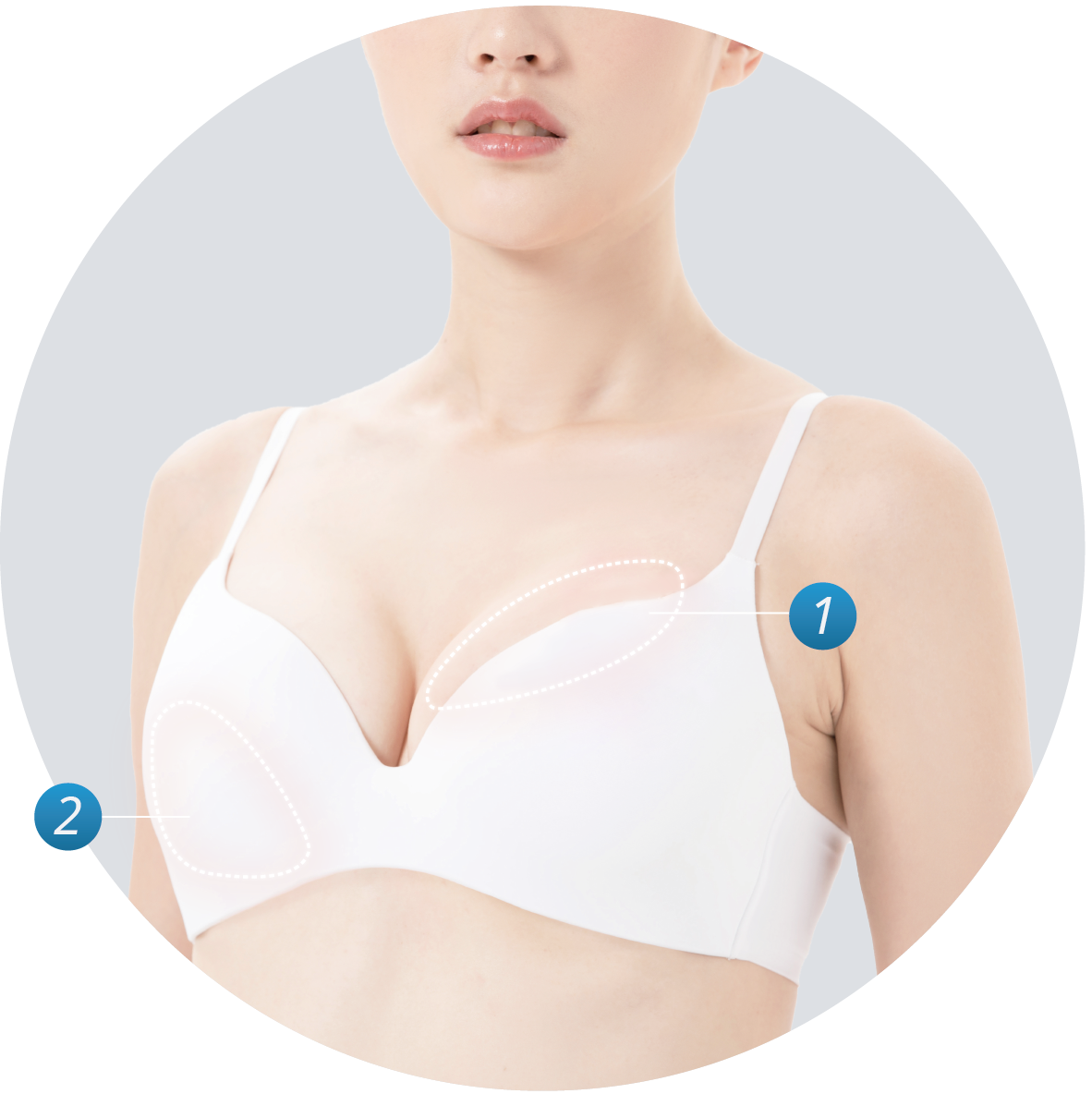
Upper Breast
Lower Breast
| Method | Fat Transfer | Breast Implants |
|---|---|---|
| Often Considered For | Modest volume or localized contour adjustment with adequate donor fat | More predictable larger volume or shape defined by implant dimensions |
| Material | Patient’s processed fat | Saline- or silicone-filled medical device |
| Incisions | Small donor incisions and breast punctures | Longer access incision for implant placement |
| Typical Surgery Time | About 2–3 hours or longer depending on areas | Varies by implant, pocket, lift, and revision status |
| Visible Recovery | Often 1–2 weeks; survival and contour settle over months | Often 1–2 weeks; pocket and scars settle over months |
| Durability | Surviving fat can be long-lasting but changes with weight and aging | Implants are not lifetime devices and may require future surgery |
| Massage | Do not massage grafted fat unless specifically instructed | Postoperative massage depends on implant, pocket, surgeon, and healing; it is not universally required |
| Key Risks | Unpredictable absorption, fat necrosis, cysts, calcifications, asymmetry, embolism | Capsular contracture, rupture, malposition, rippling, device-associated cancers, future replacement |
Upper-pole fullness, lower-pole contour, asymmetry, and selected volume loss may be treated by distributing small amounts of processed fat according to tissue capacity. Deliberate overfilling can reduce blood supply and increase necrosis, cysts, calcification, infection, and irregularity. A staged procedure may be safer than attempting a large increase at once.


Photos are published with the subject's consent and authorization. Surgical results may vary depending on individual conditions.
A modest increase is typical, but a specific 1–1.5 cup-size change cannot be guaranteed because bra sizing is inconsistent and the safe amount depends on donor fat, skin capacity, breast tissue, blood supply, symmetry, and fat survival. Larger goals may require staged grafting, an implant, or a different plan.
Fat transfer uses donor fat and usually provides modest, less predictable volume with no implant device. Implants provide a more predictable larger size but carry device risks such as capsular contracture, rupture, malposition, rippling, implant-associated cancers, and future replacement. Fat transfer instead carries absorption, necrosis, cyst, calcification, embolism, and imaging risks. Massage is not automatically required or prohibited; follow the procedure-specific plan.
There is no guaranteed 70% survival or permanent result. Some fat is reabsorbed during the first months; surviving fat can remain long term but changes with weight, pregnancy, aging, and hormonal changes. Overfilling to compensate can increase necrosis and cysts. Final assessment is usually after several months, and staged treatment may be considered.
Many patients can breastfeed, but normal milk production cannot be guaranteed. Pregnancy, prior breast development, incisions, infection, fat necrosis, and injection-related injury can affect lactation. Tell the surgeon about future pregnancy plans and consult obstetric or lactation specialists if problems arise.
Available clinical evidence has not established that cosmetic fat grafting causes breast cancer, but no procedure can eliminate a person’s baseline risk. Fat necrosis and calcifications can create lumps or imaging findings that require additional testing or biopsy. Complete appropriate preoperative assessment, continue age- and risk-based screening, report new breast changes, and always tell the imaging facility about prior fat grafting.
Suitability depends on health, breast findings, donor fat, surgical volume, and anesthesia. Report breast symptoms, abnormal imaging or biopsy, cancer history or risk, diabetes, seizures, bleeding or thrombotic disorders, abnormal scarring, allergies, cardiovascular disease, prior breast surgery, and all medicines and supplements. Active infection or unresolved breast findings should be evaluated first. Elective surgery is generally deferred during pregnancy; breastfeeding requires assessment. Patients under 18 need a legal representative. Do not stop aspirin, anticoagulants, hormones, or prescriptions without the prescribing physician. Avoid smoking and alcohol as instructed, follow fasting rules, and arrange an adult escort.
Take medicines and attend follow-up as directed. Keep donor and injection sites clean and dry until cleared. Wear only the support or compression garments prescribed for each area; do not apply excessive pressure or massage grafted breasts unless instructed. Contact the clinic for heavy bleeding, rapidly increasing swelling, severe pain, fever, pus, breast redness, shortness of breath, chest pain, fainting, or one-sided leg swelling. Avoid smoking, alcohol, soaking, swimming, heavy lifting, and strenuous exercise for the specified period. Do not start or stop medicines without advice.
Possible complications include bleeding, infection, scars, donor-site irregularity, prolonged swelling, asymmetry, under- or overcorrection, fat necrosis, oil cysts, calcification, firmness, chronic pain, sensation change, delayed healing, and revision. Imaging may prompt additional tests or biopsy. Fat embolism, blood clots, pulmonary embolism, severe infection, anesthesia complications, and death are uncommon but serious.
There is no single upper age limit, but breast development should be complete and legal consent requirements apply. Health, breast cancer risk and screening, donor fat, skin quality, pregnancy plans, smoking, medications, and anesthesia risk matter more than age alone. Patients under 18 require a legal representative and careful assessment of maturity and need.
Light walking is usually encouraged early to reduce clot risk, but strenuous exercise, chest loading, impact, and heavy lifting should wait until the surgeon confirms healing. Timing depends on donor areas, breast wounds, swelling, pain, anesthesia, and complications. Stop and seek advice for increasing pain, swelling, redness, shortness of breath, chest pain, or leg swelling.
It can. Fat necrosis, oil cysts, scarring, and calcifications may appear on mammography, ultrasound, or MRI and can occasionally require additional imaging or biopsy to distinguish them from disease. Screening is still possible. Keep operative records, tell the imaging facility about prior fat grafting, and follow the screening schedule recommended for your age and individual risk.
The breasts look larger immediately because of grafted fat and swelling. Swelling decreases and some fat is reabsorbed over the following months. A more stable estimate is often possible around 3–6 months, but scars, firmness, weight, hormones, pregnancy, and aging continue to change the result.
This information is for reference only. Treatment must be assessed by a physician based on each person's condition. Results and risks vary; consult a qualified physician and follow medical advice.